
You should change your hot tub water every 3 to 4 months, but in Colorado, that window often closes sooner. Altitude, hard mountain water, and intense UV exposure at elevation all accelerate chemical breakdown and dissolved solid buildup.
In Avon, Glenwood Springs, and the Roaring Fork Valley, the question of how often to change hot tub water has a different answer than you will find on most national sites.
Colorado Pool + Spa Scapes gives you the real Colorado-specific answer, and a simple way to know exactly when your water is ready to go.
The 3 to 4 Month Standard – and Why It Does Not Tell the Full Story
Most manufacturers and industry bodies recommend a full drain and refill every 90 to 120 days. The Pool and Hot Tub Alliance bases this on how quickly total dissolved solids (TDS) accumulate in a typical tub under average conditions.
TDS is the core issue. Every time someone soaks, they introduce body oils, sweat, lotions, and organic matter. Your sanitizer breaks those down, but the byproducts remain dissolved in the water. Over time, TDS climbs past the point where chemistry can be reliably controlled, no matter what you add. The PHTA sets the practical threshold at 1,500 ppm above your fill-water baseline.
How Colorado Changes the Equation
For hot tub owners in the mountains, understanding pool and hot tub maintenance in Colorado starts with recognizing what makes this environment different.
Sanitizers Work Less Efficiently at Altitude
At elevations above 6,000 feet, which covers Avon, Glenwood Springs, Basalt, Carbondale, and most of the Roaring Fork Valley, lower atmospheric pressure causes chlorine and bromine to off-gas more quickly. You need more product to hold the same residual sanitizer level. More chemical input means more dissolved byproducts building up in the water faster. The effective water life is shortened even with consistent maintenance.
Colorado Mountain Water Is Hard
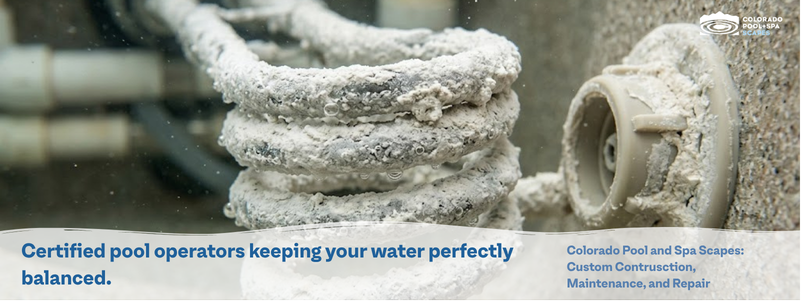
Water with dissolved calcium and magnesium above 120 mg/L is hard water, and much of Colorado’s mountain water by far exceeds that. That mineral load goes straight into your tub when you fill it. Calcium carbonate scales heaters, jets, and plumbing over time and frequent top-offs during summer only make it worse.
UV Exposure Speeds Evaporation and Chemical Loss
Colorado sees over 300 sunny days per year, and high-altitude UV is significantly stronger than at sea level. Outdoor tubs lose water to evaporation faster, which means more frequent top-offs with fresh fill water. Each top-off dilutes chemistry slightly but does not reset TDS. The net result is that chemical inputs increase and effective balance time decreases.
Vacation Properties See Concentrated Bather Load
Many tubs in mountain communities serve vacation rentals or second homes, just sitting quietly for stretches, then running continuously during peak rental weeks. That pattern is one of the hardest to handle in water chemistry. A tub used intensively over a long weekend by multiple guests without pre-soak showers can accumulate more TDS in 48 hours than a residential tub accumulates in a month.
 A Colorado-Adjusted Drain Schedule
Rather than a single calendar-based answer, here is a practical framework based on how mountain tubs actually get used:
| Use Pattern | Recommended Interval |
| Light residential use (1-2 people, consistent routine) | Every 3 to 4 months |
| Moderate family use (3-4 people, regular soaking) | Every 2 to 3 months |
| Vacation rental or high-traffic property | Every 4 to 6 weeks during active seasons |
| Tub at an altitude above 8,000 feet with hard source water | Check TDS monthly, drain when the threshold is reached |
Test TDS monthly regardless of use type. A basic digital TDS meter costs under $20 and removes the guesswork entirely. When your reading exceeds your fill water baseline by 1,500 ppm, it’s time to drain it.
Signs Your Hot Tub Water Needs Changing Now
Sometimes the water tells you before the schedule does. Do not wait for a date if you are seeing these.
- Foam returns within minutes of shocking, high TDS and organic load; chemistry cannot break it down
- Water stays cloudy after balancing, filter saturation, or TDS overload. The only fix is fresh water
- Strong chemical smell with correct sanitizer levels, combined chlorines or bromamines building up
- Skin irritation or eye redness after soaking, pH or sanitizer imbalance that repeated adjustments are not fixing
- TDS reading 1,500+ ppm above your fill water baseline, the chemical threshold for a drain
If two or more of these are present at once, do not wait. Drain, clean the shell, and refill.
What to Do at Each Water Change
A full water change involves specific steps.
- Before draining, flush the jets for 20 minutes.
- Drain fully, clean the shell, and rinse filters.
- Refill through the filter housing to avoid airlocks.
- Finally, balance alkalinity (80-120 ppm), pH(7.4-7.6), and sanitizer (1-3 ppm chlorine or 3-5 ppm bromine)
- In Colorado, always add a sequestering agent to manage hard water and prevent equipment scaling.
Colorado Pool + Spa Scapes handles hot tub and pool maintenance for mountain property owners throughout the valley, including full drain-and-refill service with post-fill chemistry tailored to your source water and elevation.

Not Sure Where Your Water Stands? We Can Help
Figuring out how often you should change hot tub water is easier when you are not doing it alone. For mountain property owners in the Roaring Fork Valley, the Vail Valley, and surrounding areas, Colorado Pool + Spa Scapes offers pool and hot tub maintenance in Colorado built specifically for elevation, hard water, and the seasonal use patterns that make mountain tub ownership different.
Colorado Pool + Spa Scapes serves hot tub and pool owners throughout the Roaring Fork and Vail Valleys, as well as surrounding mountain communities. If your tub is overdue for a drain or you want a maintenance schedule built around your elevation and usage patterns, Colorado Pool + Spa Scapes is the local team that knows what mountain water can do to equipment.
FAQ: How Often to Change Hot Tub Water
How often should you change the water in a hot tub in Colorado?
Colorado owners should drain hot tubs every 2 to 3 months. High altitude, hard water, and UV exposure accelerate chemical breakdown and TDS buildup. Vacation rentals may require changes every 4 to 6 weeks. Monitor TDS monthly; a full drain is required once levels exceed your baseline by 1,500 ppm.
What is the formula for calculating how often to change hot tub water?
The standard formula for calculating the water-change interval is to divide the tub’s gallon capacity by 3, then divide that result by the average number of daily bathers, which yields the interval in days. For example, a 400-gallon tub with two daily bathers suggests a 67-day change. In Colorado, use this formula conservatively and rely on monthly TDS testing for confirmation.
Can you add fresh water instead of draining it completely?
Partial additions dilute TDS but won’t reset it. Topping off is a temporary fix that doesn’t restore chemical balance once TDS is elevated. A full drain-and-refill is the only true reset, which is especially critical in Colorado given the naturally high mineral content of mountain water.
How do you know when the hot tub water has passed the point of no return?
Drain your tub if TDS levels exceed your baseline for fill water by 1,500 ppm. Physical indicators include persistent foam after shocking, cloudy water that won’t clear, strong chemical odors despite proper levels, or skin and eye irritation. If two or more symptoms appear, a full reset is necessary.