
The cost to run a hot tub in winter in Colorado comes down to how many kilowatt-hours the heater uses, and that depends mostly on the cover, the insulation and your set temperature.
An efficient, well-covered tub uses a fraction of the energy of a poorly insulated one, so two tubs on the same street can run very differently through a mountain winter.
Key takeaways
- A poorly insulated tub can use more than twice the energy of an efficient, well-covered one.
- A soaked or poorly fitting cover is the first thing to check when the bill jumps.
- In Colorado’s mountain resort communities, switching a tub off to save energy can lead to freeze damage.
- On a time-of-use plan, heating outside evening peak hours lowers the bill.
How Much Electricity Does a Hot Tub Use?
A hot tub’s heater runs to replace the heat the water loses, so the bill follows how much heat escapes.
Typical Daily Use
Washington State University’s Energy Program puts a typical efficient tub at 5 to 7 kWh a day. A poorly insulated one? Closer to 12 to 18. Those numbers come from a 2003 factsheet, so nobody measured them in a Colorado January.
Up here, long nights below freezing push most tubs toward the top of their range.
Estimate Your Own Tub
kWh per day × 30 days × the rate on your utility bill = monthly cost
Not sure what your tub uses? A plug-in power meter or your utility’s smart-meter data will show it, and comparing it with the ranges above shows whether your tub sits at the efficient end.
What Drives the Cost to Run a Hot Tub in Winter?
Four things decide whether a tub sits at the low or the high end of its range.
| Factor | Uses less energy | Uses more energy |
|---|---|---|
| Cover | Dry foam, snug fit (about R-12) | Waterlogged or broken foam |
| Insulation | Newer, well-insulated cabinet | Older, poorly insulated tub |
| Set temperature | 102°F | 104°F factory setting |
| Wind | Panels, landscaping or fencing | Exposed deck |
Source: WSU Energy Program.
When the Bill Suddenly Jumps
A jump with no change in how often you soak usually points to a problem, not the weather. WSU names a waterlogged cover as a cause of higher energy use, and a failing heater or temperature sensor can keep a tub heating when it shouldn’t.
If that sounds familiar, schedule hot tub maintenance with Colorado Pool + Spa Scapes before the next billing cycle.
Is It Cheaper to Leave a Hot Tub On All Winter?
If you soak regularly, keeping it on at a steady temperature is usually the simpler and safer choice, and it keeps the cost to run a hot tub in winter predictable.
When You’ll Be Away
For a week or more away, the WSU Energy Program suggests lowering the heat. It also notes that efficient tubs with good covers can stay above freezing for weeks, while older tubs can freeze and damage equipment.
That’s the catch for vacation homes in Colorado’s mountain resort communities. Any energy saved by switching off isn’t worth a cracked line, so for a long absence, book a hot tub winterizing service instead.
Keeping the power on, the water at level and the cover closed is the core of using a hot tub in winter in Colorado safely.
How to Lower Your Hot Tub Electric Bill in Winter
Three changes cut heat loss or shift when you use power.
Heat Outside Evening Peak Hours
Plenty of Colorado utilities now bill by time of day, and the evening is usually when power costs the most. Check your bill or call your utility to see whether you’re on one of these plans and when its peak window falls.
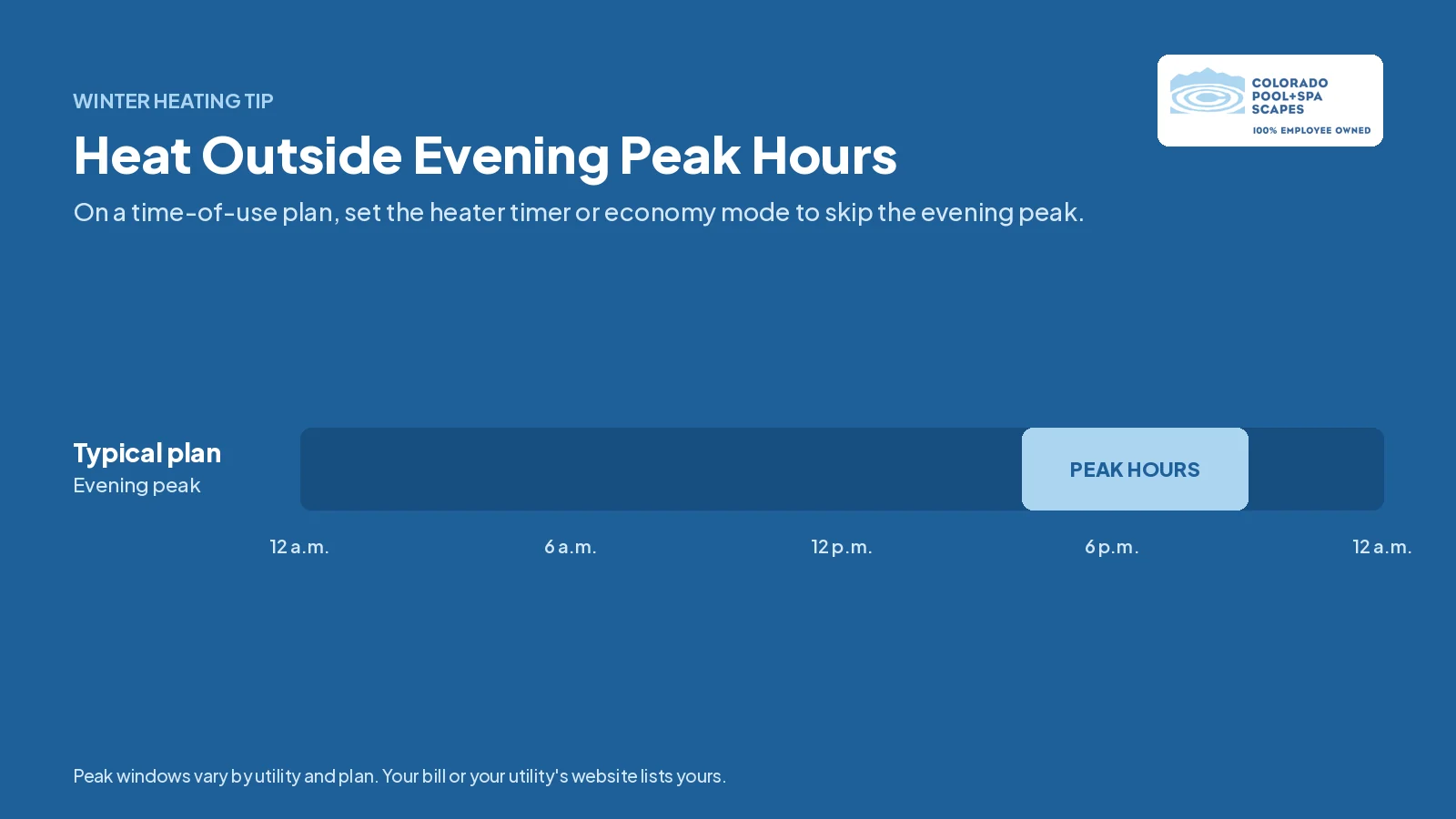
If your tub has a timer or economy mode, set the heater to avoid those hours. WSU notes that a well-insulated tub holds its temperature for several hours after the heater shuts off.
Check Your Hot Tub Cover
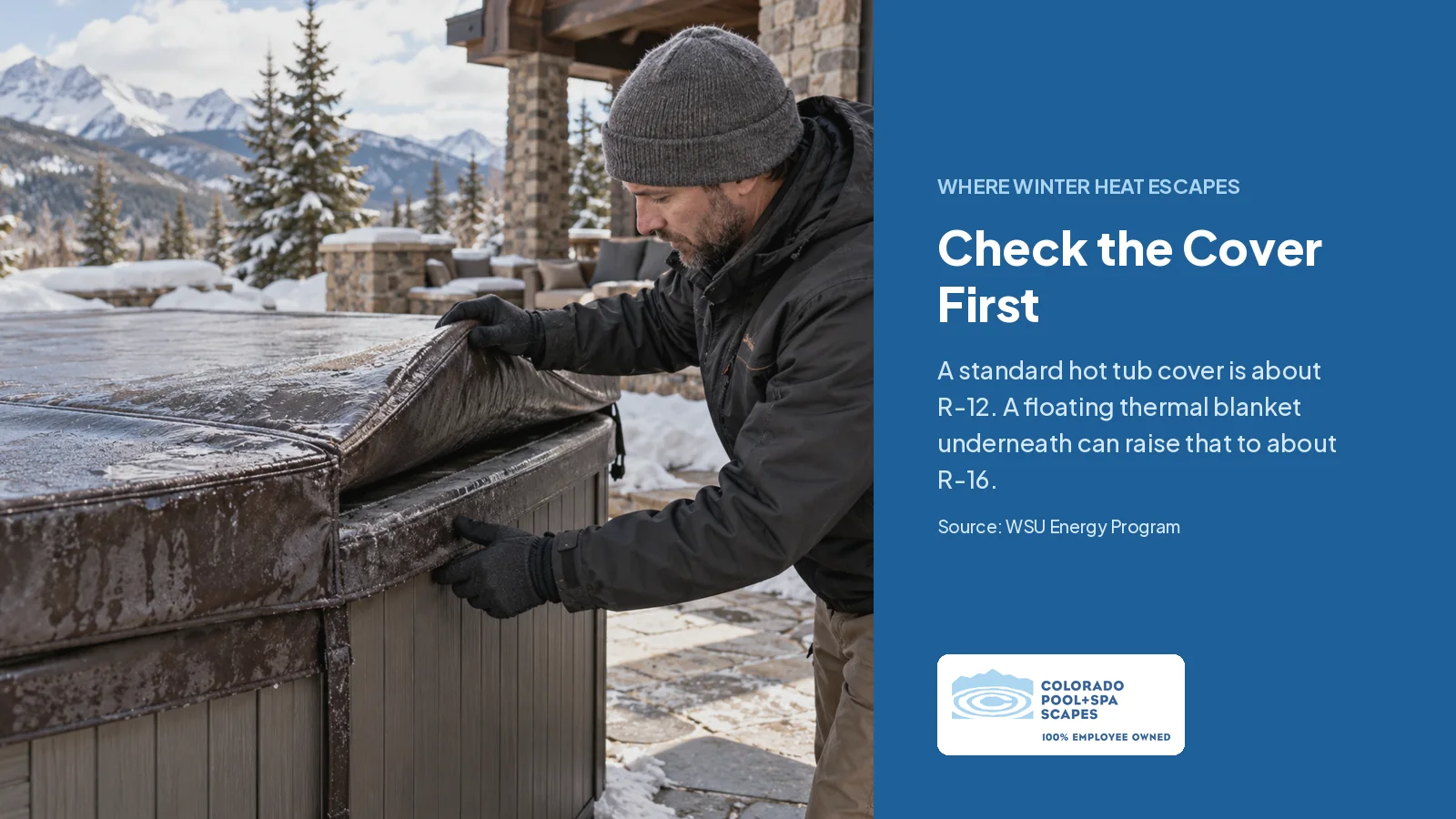
Per WSU, a standard cover is about R-12, and a floating thermal blanket under it can raise that to about R-16.
- Replace a soaked cover. Broken or waterlogged foam raises energy use.
- Check the fit. The cover should sit snugly on the tub lip, with the straps latched.
- Add a floating blanket. It goes under the hard cover for extra insulation.
If yours is past saving, compare replacement hot tub covers.
Block the Wind and Check the Set Point
WSU says privacy panels, landscaping or fencing cut wind exposure and reduce heat loss. It also notes that most health departments recommend 102°F, while some tubs are factory-set to 104°F, so check yours.
For an old, poorly insulated tub, WSU recommends a newer, efficient model, so compare current hot tubs for sale in Colorado.
Bring Your Winter Hot Tub Bill Back Down
If the cost to run a hot tub in winter at your home seems higher than it should be, the cover and the heater are the first two places to look.
Have a Technician Check the Cover and Heater
Colorado Pool + Spa Scapes services hot tubs in Vail, Aspen, Steamboat Springs and nearby mountain towns. A maintenance visit shows what’s worth fixing and what’s normal for a tub at elevation.
Book a Hot Tub Maintenance Visit
Hot Tub Winter Cost FAQs
How much electricity does a hot tub use in winter?
WSU’s figures are 5 to 7 kWh a day for an efficient tub and 12 to 18 for a poorly insulated one. In a mountain winter, expect to land near the top of whichever range fits your tub, and higher if the cover is waterlogged. A plug-in meter will tell you for sure.
Why does a hot tub use more electricity in winter?
Colder air and wind pull heat out of the water faster, so the heater cycles on more often to keep up. A tight, dry cover and something to block the wind slow that down. Dropping from a 104°F factory setting to 102°F, which most health departments recommend, helps too.
Is it cheaper to run a 110 or 220 hot tub?
Voltage doesn’t change the price of a kilowatt-hour. The bill follows how many kWh the tub uses, which depends on insulation, the cover and heater run time. A 120V tub usually has a smaller heater that recovers more slowly in cold weather, so ask how a model handles mountain winters.
Should I run my hot tub all winter?
Most owners here do. Keep it on, heated and covered, and it protects itself from the cold. The exception is a long trip: if nobody will use or check the tub for weeks, have it winterized instead of switching it off. And run the heater on a timer outside evening peak hours.
